The Northern Michigan Market Perspective

Thoughtful observations on today's market from Gordon Liechti, GRI

Area Real Estate News & Market Trends

Welcome to my blog! Here, you'll find expert insights on local real estate, including market trends, home values, community information, and financial tips to help you make informed buying and selling decisions. Whether you're a first-time buyer, a seasoned investor, or just exploring your options, my goal is to provide up-to-date, valuable content. Stay tuned for articles on market statistics, neighborhood highlights, and tips to navigate your real estate journey!

Feb. 26, 2026

How Buyers Are Navigating Affordability in 2026 | Grand Traverse Real Estate


How Buyers Are Navigating Affordability, Rates, and Negotiation in 2026

As we move deeper into 2026, the real estate market — both nationally and locally in Greater Traverse — is settling into a phase that’s very different from the rapid escalation of recent years. Prices aren’t plummeting, but they are stabilizing. Mortgage rates are down from recent peaks, but still elevated compared to the past decade. Buyers today are responding with strategy, patience, and a focus on long-term value.

Below is a balanced look at what buyers are navigating right now — with data and context that matter in the real world.


1) Mortgage Rates: Low-Volatility, Still a Key Affordability Factor

Recent data shows the average U.S. 30-year fixed mortgage rate dipping to about 6.01%, its lowest level in more than three years, bringing a bit of breathing room back into affordability.

Even modest rate improvements matter for monthly payments, and they can open the door for buyers who had previously been priced out. But rates aren’t at the historic lows many remember from pre-2021, so buyers are balancing rate optimism with caution.

What This Means for Buyers:

  • Lower rates improve overall affordability compared to last year

  • Buyers are increasingly thinking long-term, with refinancing as an option

  • Small changes in rate (~.25–.50%) can still meaningfully impact monthly cost


2) Inventory, Timing, and Negotiation Leverage

Inventory remains constrained nationally and locally, but not as tight as it was during the peak frenzy. This has several effects:

  • Negotiation leverage is returning for buyers — fewer bidding wars and more room to ask for contingencies or concessions

  • Buyers are increasingly using inspection and appraisal clauses rather than waiving them

  • Sellers are still cautious about listing if they don’t have a next-step plan, keeping availability lower

In Greater Traverse and Traverse City specifically, prices have shown modest year-over-year stability, with average values up in the low single digits over the past year.

Locally:

  • The median listing price in Grand Traverse County was around $479,900 in early 2026.

  • Home values in Traverse City proper sit around $424,000–$425,000, trending slightly higher than a year ago.

  • Days on market and pending timelines are trending shorter than they were last year, indicating continued buyer interest even in slower winter months.

Buyers in this market still need to be prepared — but they’re no longer entering a zero-sum bidding war in most segments. This generates negotiation power and leads to more thoughtful offers.


3) Affordability Strategy: Smart Timing, Not Perfect Timing

Instead of chasing the absolute lowest possible rate, many buyers are adopting a more thoughtful approach:

Buy now with an eye toward refinancing later if rates improve
This gives buyers access to homes they like, without waiting indefinitely for a rate that may not drop quickly.

Focus on total monthly payment
Buyers are factoring insurance, taxes, and local carrying costs into their affordability calculations.

Look beyond the headline rate
Local market dynamics (inventory, competition, neighborhood stability) matter just as much as nominal mortgage percentages.


4) Lakefront & Waterfront Buyers: Patience with Purpose

Lakefront buyers in Northern Michigan — whether looking at Torch Lake, Elk Lake, Glen Lake, or Lake Michigan shoreline — are typically long-term thinkers. Because high-quality waterfront inventory is limited:

  • Pricing is often more resilient

  • Value tends to hold better over time

  • Premium features (walk-in frontage, deeper water, views) sustain interest

Many lakefront buyers are recognizing that long-term value can outweigh a minor rate fluctuation, especially when financing strategy can adapt over the life of ownership.


5) Making Offers That Win (Without Overpaying)

In today’s market:

  • Clean offers with clear financing often rise above others

  • Inspection contingencies are seen as reasonable rather than risky

  • Letters that speak to buyer readiness but not emotion can help offers stand out

  • Sellers value certainty over speed alone

This isn’t the take-no-prisoners market of a few years ago — it’s one where smart negotiation matters.


The Practical Takeaway for Buyers in 2026

This market rewards prepared, informed, and flexible buyers:

✔ Understand your budget and look beyond headline rates
✔ Be ready to negotiate — leverage exists
✔ Don’t let perfect timing stand in the way of smart decision-making
✔ Focus on value and fit, not just rate alone

Affordability, rates, and negotiation interplay in ways that matter — but your goals, financing strategy, and timing will always be the strongest drivers of success.


If you’d like personalized insight into your affordability range or negotiation strategy — especially in the Grand Traverse lakefront market — I’m always happy to walk through the numbers and opportunities with you.


Gordon Liechti, GRI
The Mitten Realty Group

 

Posted in BUYING A HOME
Jan. 19, 2026

The Question Defining the 2026 Real Estate Market


       “Should I make a move now, or wait?”

As we enter 2026, the real estate market is no longer driven by urgency or fear of missing out. Instead, it has shifted into a more thoughtful, decision-driven environment—one where buyers and sellers are carefully weighing timing, value, and personal readiness.

Mortgage rates have stabilized in the low-6% range, an improvement from much of 2024–2025, while housing inventory is slowly rising after years of severe constraint. Even so, the market remains expensive by historical standards, and inventory is still well below pre-2020 norms.

This combination has led to the single most common question buyers and sellers are asking today:

Is now the right time to act—or is it better to wait?


A Snapshot of the 2026 Market

While conditions vary by region and price point, several national and regional trends are shaping decisions early this year:

  • Mortgage rates: Generally hovering between 6.0%–6.5%, with far less week-to-week volatility than in prior years

  • Inventory: Expected to rise approximately 10–15% in 2026, though still 30–40% below pre-2020 levels in many markets

  • Home prices: Largely stable, with modest appreciation expected for well-located, move-in-ready homes

  • Days on market: Increasing slightly, signaling a shift away from urgency and toward selectivity

This is not a weak market—but it is a more disciplined one.


What Buyers Are Weighing Right Now

Buyers today are far more analytical than they were during the pandemic years.

  • Mortgage rates remain elevated compared to the last decade, but are far more stable

  • Inventory nationally is expected to increase 10–15% in 2026, though many local markets remain tight

  • Home prices have largely flattened, with modest appreciation expected in well-located, move-in-ready properties

The key decision for many buyers is not if rates will eventually come down, but what waiting may cost in terms of price, competition, and opportunity.

Many are asking:

  • Should I buy now and refinance later?

  • Will increased inventory actually improve affordability?

  • What happens if rates drop and competition returns quickly?

In many cases, buyers who are financially prepared are finding more negotiating leverage today than they’ve had in several years.


What Sellers Are Considering Right Now

Sellers are adjusting to a more balanced market—one that rewards preparation and realism.

  • Buyers are more selective

  • Pricing accuracy matters more than ever

  • Homes that are properly prepared and priced are still selling, while others sit longer

While many homeowners hold significant equity, the days of “test the market” pricing are largely over. Sellers are increasingly focused on:

  • Strategic pricing from day one

  • Thoughtful improvements that generate real return

  • Timing the market around lifestyle and financial goals, not headlines

For many sellers, the question is not whether values will collapse—but whether waiting truly improves outcomes.


The 2026 Market Reality

  • Inventory is improving, but remains historically low

  • The market is more balanced, not slow

  • Well-priced, well-presented homes continue to perform best

The biggest shift in 2026 is psychological: decisions are being made with clarity rather than urgency.

In this market, the “right time” isn’t universal—it’s personal. The most successful buyers and sellers are those aligning the market with their goals, not trying to predict perfect timing.

Gordon Liechti, GRI
The Mitten Realty Group

Posted in BUYING A HOME
Jan. 19, 2026

Traverse City Real Estate: A Market That’s Finding Its Balance

Dear friends & clients,

I wanted to share a brief update on what’s happening in the Traverse City real estate market as we move through early 2026.

After several years of rapid, post-pandemic growth, the market is beginning to settle into a more balanced rhythm. Prices remain resilient, though growth has slowed to a more sustainable pace. At the same time, inventory has increased, giving buyers more choice and slightly more room to negotiate than in recent years.

That said, not all properties are behaving the same way. Waterfront homes, bay views, and well-maintained, move-in-ready properties continue to see very strong demand, often selling quickly when priced appropriately. In fact, quality lakefront properties remain among the most competitive segments of the Northern Michigan market due to limited supply and continued lifestyle-driven demand.

Interest rates have tempered some activity, making buyers more thoughtful and strategic, but they haven’t dampened overall interest in Northern Michigan living. Well-priced homes are still attracting solid offers, and buyers who are prepared and decisive are finding opportunities.

What this means right now:

  • Buyers: More options and some negotiation room, but desirable properties still move fast.

  • Sellers: Demand remains strong, especially for premium homes, though accurate pricing is more important than ever.

Overall, the Traverse City market appears stable, active, and healthy, offering opportunity for both buyers and sellers who approach it thoughtfully.

If you’d like to discuss how this applies to your specific situation—lakefront or otherwise—I’m always happy to help.

Warm regards,

Gordon Liechti, GRI
The Mitten Realty Group
Posted in BUYING A HOME
Dec. 12, 2025

Your Best Chance of the Year to Negotiate? It Might Be Right Now


As we move into early winter here in Northern Michigan, a few of you have been asking whether this quieter season is a smart time to buy a home. I wanted to share a quick update based on what I’m seeing in the Grand Traverse market right now.

Is This a Good Time to Buy in Northern Michigan?

For many buyers, late fall and early winter can be one of the best times of the year to purchase a home. With fewer buyers in the market, there’s less competition and more room to negotiate—something we don’t often see during the busy spring and summer months.

Why Buying Now Can Be a Smart Move:

Less Competition: Fewer buyers means fewer bidding wars and a better chance of securing a home at a fair price.
More Motivated Sellers: Sellers who stay on the market this time of year are often ready to make a deal.
Stronger Negotiation Power: This season can open the door to successful lower offers—especially on homes you’ve been watching that sit slightly above your budget.
Seasonal Price Advantages: Historically, late-year pricing softens in our area.
A Few Things to Keep in Mind:
• Inventory is lower this time of year, so selection can feel tighter.
• Weather can make viewing conditions tougher, but it also reveals how well a home handles a Northern Michigan winter.
Bottom Line:
If your priority is value and negotiation rather than the widest selection, this may be a great window to take action. I’m happy to talk through your goals, review properties you’ve been considering, or keep an eye out for opportunities that fit your budget and timing.

Warm regards,

Gordon Liechti, GRI
The Mitten Realty Group
Northern Michigan Real Estate
Nov. 14, 2025

“What Northern Michigan’s 9,000+ Short-Term Rentals Mean for Today’s Real Estate Market”


Land Of 9,000 Airbnbs: Northern Michigan's Short-Term Rental Market, By The Numbers

By Craig Manning | Nov. 12, 2025

Short-term rentals (STRs) have been blamed for dwindling housing stock and skyrocketing real estate prices in northern Michigan, and local units of government have had to contend with the question of how to regulate them. But how many STRs does the region actually have? The Ticker sat down with Bram Gallagher, director of economics and forecasting for the STR data tracking company AirDNA, to crunch the numbers.

Launched in 2015, AirDNA claims to provide “the most accurate and comprehensive vacation rental data and analytics in the world.” Using scraped data from popular STR services like Airbnb and VRBO, as well as “partner data” from individual STR hosts, property managers, and channel managers, AirDNA is able to keep close tabs on listing numbers, vacation rental revenues, occupancy rates, and other key STR data. Worldwide, AirDNA’s data is used by everyone from journalists to tourism professionals to actual vacation rental hosts, to gain a better understanding of the STR market. Locally, Traverse City Tourism relies on the company’s analytics to monitor where and how vacation rentals are figuring into the regional tourism scene.

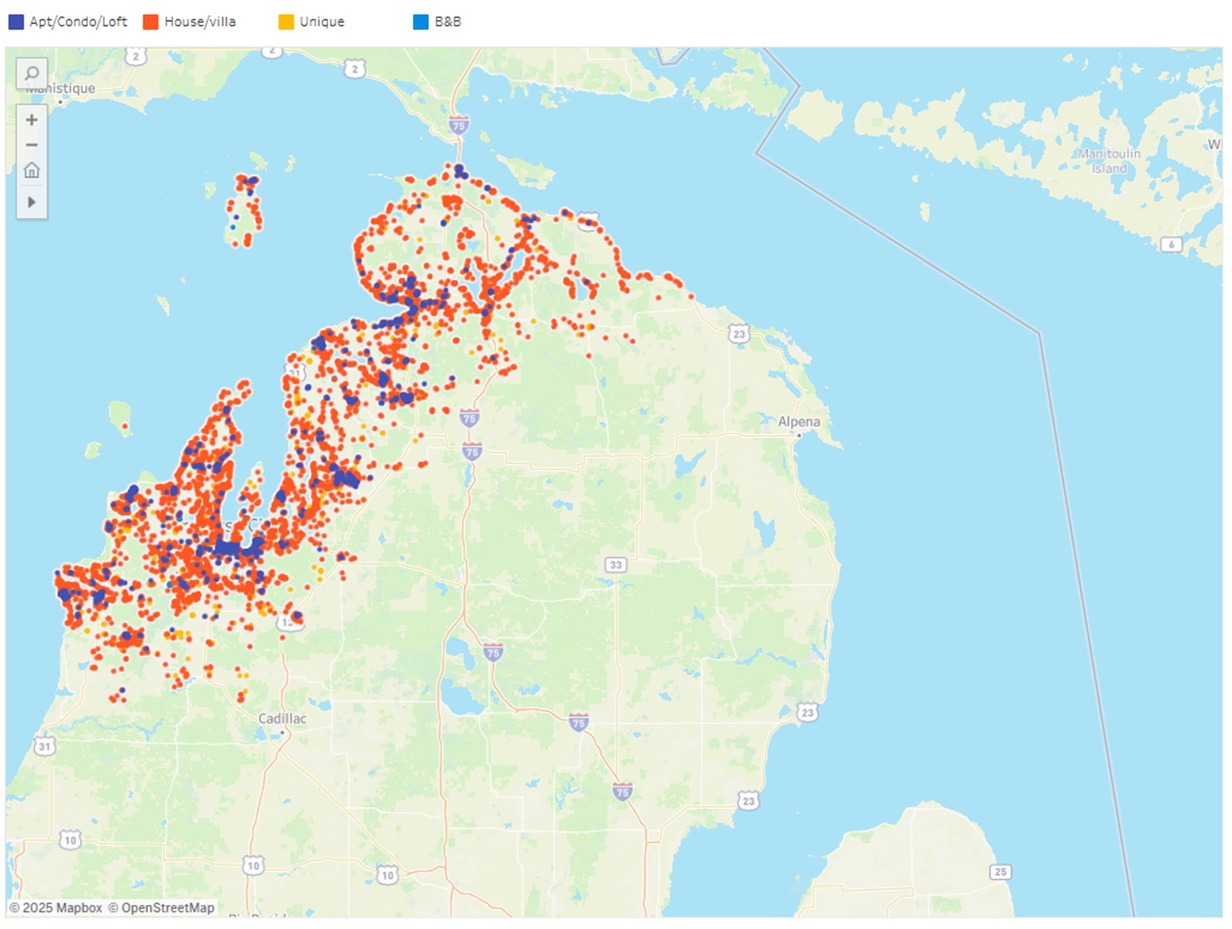
Based on a request from The Ticker, Gallagher compiled an exhaustive STR report for northern Michigan’s “north coast” market (pictured). That region spans from Benzie and Leelanau counties in the west and then runs northeast through Grand Traverse and Antrim, up into Charlevoix, Emmet, Cheboygan, and Presque Isle counties, all along the Lake Michigan and Lake Huron coasts. While the territory reaches beyond what is typically considered the Grand Traverse region, the data still offers compelling snapshot of STR growth in the area.

Here are a few by-the-numbers takeaways:

9,130: The number of available STR listings across the north coast market in August of this year. STR listing numbers fluctuate significantly throughout the year, but typically peak in August or September, based on monthly AirDNA data dating back to January 2021. In 2025, listing numbers were at their lowest in February (6,142), spiked to about 8,300 in May, and then hovered around the 9,000 mark for the duration of the peak summer tourism season.

What type of real estate is being taken off the market by STRs? AirDNA data shows that 1,687 of the available listings were one-bedroom units, 2,417 were two-bedrooms, 2,235 were three-bedrooms, 1,345 were four-bedrooms, 584 were five-bedrooms, 239 had six bedrooms or more, another 239 were individual rooms inside occupied homes, and 384 were studio apartments. As the image provided by AirDNA shows, the vast majority of the region's STR listings are homes, not apartments.

40%: The share of local STRs available for rental year-round. “That means the other 60 percent are occupied or unavailable some part of the year,” Gallagher says. “That kind of split happens quite frequently in markets like yours. People will have second homes, will have vacation homes or lake houses, and they will use them for some part of the year.”

39.7%: The growth of STR listings in northern Michigan between August 2021 – when AirDNA tabulated 6,534 listings across the north coast – and August 2025.

While that increase is substantial, Gallagher notes that growth in the local market has largely plateaued in recent years. Looking at the month of August, STR supply jumped about 1,000 units per year from 2021 through 2023, but only grew by about 500 listings from 2023 to 2024. The increase from August 2024 to August 2025 was only 113 units.

“I think some of the regulations that that are going into effect in the Traverse City area are having some effect,” Gallagher says. “I say that because the number of individual listings have really leveled off since 2024. This year, we are seeing very, very little supply growth – and in fact, during the off season, we actually saw a little bit of supply shrink in this area.”

Take February: In 2024, that month saw 6,276 STR listings in the north coast market; this February, the number dropped to 6,142 – about a 2.1 percent decline.

220,617: The number of available listing nights in August of this year across the north coast STR listings – the highest for any month on record.

How does that number compare to the capacity provided by the local hotel market? While not representative of the total north coast market AirDNA is tracking, Traverse City Tourism typically reports about 5,000 guest rooms in the Grand Traverse region. 5,000 hotel rooms would equate to 155,000 room nights for the month of August.

72.3%: The occupancy rate for August 2025 across all the available listing nights in the north coast STR market, meaning 159,545 of the available 220,617 listing nights were sold. Occupancy rates for 2025 range from 81.1 percent in July (when STR hosts successfully sold 176,491 of the available 212,290 listing nights) to 30.2 percent in March (which saw 30,404 listing nights booked out of the available 100,620).

Notably, that July number marks the highest level of demand ever recorded for STRs in northern Michigan, up from the previous peak of 167,077 booked listing nights in July 2024. Prior to last July, no month had ever surpassed 150,000 listing nights sold for the north coast STR market.

$445.91: The average daily rate (ADR) to rent out an STR in the north coast market in July of this year – also an all-time high for the north coast market.

“That’s a big ADR boost, compared to what your region has seen in the past,” Gallagher notes. The previous ADR peak was $412.54, in July 2024. Wind back the clock to the beginning of 2021, and the ADR was $300. “That means the bottom line is going up for these folks [who own STRs],” Gallagher adds. “As your region sees more regulations, and as you see more people demanding these rooms, you’re going to see more compression, higher occupancies, and higher prices as a result of that.”


Nov. 10, 2025

How the Fed’s 2025 Rate Cuts Could Shape Traverse City’s Real Estate Market


With two Federal Reserve rate cuts already completed this year—and the possibility of more ahead—the question on many minds is: How will this affect the Traverse City housing market?

Here’s what to know right now:

🏡 Mortgage affordability is improving.
Lower borrowing costs are bringing more buyers back into the market. If the Fed follows through with additional cuts, affordability could continue to rise, encouraging those who’ve been waiting on the sidelines.

📈 Mortgage rates remain unpredictable.
Despite the Fed’s moves, mortgage rates don’t always fall in step. They’re tied more closely to the 10-year Treasury yield, which can swing with inflation and investor sentiment.

🏠 Local inventory stays tight.
Here in Traverse City and all of northern Michigan waterfront properties, limited listings—continue to keep prices steady and competition strong. Lower rates could spark more activity, but the supply shortage remains a challenge.

🔁 Refinancing and building opportunities.
Homeowners may find better refinancing options, and builders could benefit from cheaper financing, which may slowly help increase supply in the coming year.

Looking ahead:
The Fed has two meetings left this year. While another cut is possible, it’s not guaranteed. Market reactions will depend on whether investors see the current trend as the start of a longer easing cycle—or just a brief pause.

Bottom line:
Lower rates are generally good news for both buyers and sellers, but Traverse City’s strong demand will keep our market active and competitive. Staying informed and ready to act when opportunities arise will be key in the months ahead.

I’ll continue sharing local updates as conditions evolve—stay tuned for the next Market Insight!

Warm regards,
Gordon D. Liechti
Realtor® | Traverse City & Northern Michigan Real Estate 

Sept. 13, 2025

Interest Rates and the Fed, what It Means for Traverse City Real Estate


Traverse City’s real estate market has been a consistent bright spot in Michigan, attracting buyers for downtown condos, seasonal cottages, and lakefront retreats. But with prices climbing steadily, many clients are wondering whether to wait for a possible drop in interest rates or act now.

Understanding the Fed’s Role

The Federal Reserve doesn’t set mortgage rates directly, but its policies have a major influence. When the Fed raises its benchmark rate, borrowing costs rise, pushing mortgage rates higher. When it cuts rates, mortgage rates tend to fall, which can reduce monthly payments for homebuyers.

At the moment, markets are watching closely for whether the Fed will cut rates and by how much. Even a modest cut could meaningfully improve financing options.

The Traverse City Factor

Unlike many markets, Traverse City has unique supply constraints. There is limited inventory of highly desirable condos and lakefront homes, and demand is strong year-round. A rate cut would likely spark renewed buying activity, increasing competition. That means affordability may improve on paper — but prices themselves may continue to rise as more buyers enter the market.

Should You Wait or Buy Now?

Here are three key considerations for today’s buyers:

  • Prices are resilient. In Traverse City, values have consistently trended upward, with little indication of a pullback.
  • Lower rates can trigger bidding wars. More affordable financing attracts more buyers, which can offset the savings.
  • Refinancing creates flexibility. Purchasing now means you lock in today’s property. If rates do fall later, you may refinance into a lower payment.

Strategy for Smart Buyers

Timing the market is difficult. From my experience, the savviest buyers in Traverse City focus on finding the right property rather than waiting for the “perfect” interest rate. By securing the condo, cottage, or lakefront retreat that fits your vision now, you protect yourself against further price increases — with the option to refinance later if rates improve.

Bottom Line

If the Fed cuts rates, Traverse City will almost certainly see a surge in buyer activity. Acting sooner rather than later could give you an advantage in a market where lifestyle properties are scarce and demand is constant. Please call, text or email me with any questions!

Gordon Liechti - Realtor® GRI
Aug. 23, 2025

Will Lower Rates Heat Up Northern Michigan Real Estate


Will the Fed Lower Rates in September? What It Could Mean for Northern Michigan Real Estate

The Federal Reserve has recently signaled that an interest rate cut could be on the horizon, with September being a likely timeframe. If rates are lowered, the effects on the housing market — both nationally and here in Grand Traverse and across Northern Michigan — could be significant.

What a Rate Cut Could Mean

·        Lower borrowing costs: A reduction in rates would make monthly mortgage payments more affordable, allowing more buyers to re-enter the market or increase their purchasing power.

·        Increased buyer demand: With more buyers competing, especially in our already popular region for retirees, remote workers, and “climate migrants,” competition for homes could intensify.

·        Refinancing opportunities: Current homeowners with higher-rate mortgages may see this as a chance to refinance, freeing up disposable income.

Impact on Home Prices & Inventory

·        Upward price pressure: In a market like Grand Traverse with limited supply, increased demand often leads to higher home prices, even if borrowing becomes more affordable.

·        Inventory challenges remain: While lower rates could encourage some homeowners to list, inventory levels are still well below pre-pandemic averages. Any improvement is likely to be modest.

·        Moderate, sustained growth: Rather than sharp spikes, many experts anticipate steady, sustainable price growth. That said, high-demand areas like waterfront properties will likely remain highly competitive.

The Bigger Picture in Northern Michigan
The Grand Traverse market is shaped by unique local drivers beyond interest rates. The region’s strong appeal as a destination for tourism, retirement, and remote work provides resilience in the face of national trends. Demand for desirable properties — particularly waterfront and other high-amenity locations — is expected to remain strong regardless of Fed policy.

Bottom Line
While a potential rate cut would ease borrowing costs and provide opportunities for buyers and current homeowners, it’s unlikely to fully resolve the affordability challenges in our region. Limited supply means competition and upward price pressure will remain central features of our market.

If you’d like to discuss what these changes could mean for your situation — whether you’re considering buying, selling, or simply curious about the current value of your home — I’d be glad to help.

Best regards,
Gordon Liechti – REALTOR® GRI – Traverse City, MI

Aug. 12, 2025

First-Time Buyers: How to Find Affordable Homes in Traverse City Without Breaking the Bank

Buying your first home is a big moment. Exciting, no doubt. But let’s be honest—it can also feel overwhelming, especially in a market like Traverse City real estate where competition is stiff and prices seem to edge up every season.

Good news though: You can absolutely find affordable homes in Traverse City. You just need the right plan, patience, and a little local know-how.

Today, I’m going to walk you through it all. From smart search strategies to avoiding common traps, this guide is your step-by-step map for finding a place you love without emptying your wallet.

Why So Many First-Time Buyers Are Choosing Traverse City Real Estate


Buyers find numerous appealing factors which attract them to this location.

Traverse City combines small-town appeal with beach access and downtown vibrancy which together create fantastic outdoor adventure opportunities. Buyers gain access to these benefits along with a unique sense of community which is uncommon in today’s world.

And compared to bigger cities, homes for sale in Traverse City often deliver more value for the money—whether you're buying a starter condo or a cozy family home.

That said, prices have risen. So, today, buyers must combine intelligence with speed and adaptability to secure transactions that meet their satisfaction.

The Top Five Mistakes First-Time Buyers Encounter (Plus Tips to Avoid Them)
Let's first discuss the strategies to avoid before we learn how to make smart purchasing decisions.

Mistake 1: Shopping Without Pre-Approval
Without pre-approval your shopping experience turns into window shopping. Sellers won’t take you seriously until you have that letter in hand.

Mistake 2: Chasing Perfection
There is no perfect house. Even brand-new builds have flaws. Focus on the big things—structure, layout, location—and let go of tiny imperfections.

Mistake 3: Overstretching the Budget
It’s tempting to max out your approval limit, but don’t. Leave room for repairs, furnishings, unexpected expenses, and life. Mortgage fatigue is real.

Mistake 4: Waiting Too Long
You like a house. You hesitate. Somebody else buys it. In Traverse City’s market, you have to be ready to move when the right opportunity pops up.

Mistake 5: Relying Only on Big Websites
Zillow, Redfin, Realtor.com—they're fine for browsing. But the best deals on Traverse City affordable homes often come through local agents who know about upcoming listings before the rest of the internet.

How to Actually Find Affordable Homes for Sale in Traverse City

Now let’s flip to the good stuff. Here’s what works for buyers who succeed:

1. Lock Down Your Financing Early

Before you look at a single home, get pre-approved with a lender. Know your real numbers, including monthly payment, taxes, and insurance.

Don’t just focus on the purchase price. Focus on what you’re comfortable paying every month, too.

A good lender will break this down clearly for you. If they don’t, find another one. Seriously.

2. Choose the Right Agent (It Matters More Than You Think)

Not all agents are created equal.

You want someone local, someone who eats and breathes Traverse City real estate, and someone who has closed deals for first-time buyers recently.

Ask questions like:

  • How many first-time buyers have you helped in the past year?
  • How familiar are you with affordable listings?
  • Can you help me spot value and avoid money pits?

A skilled agent will not only find homes faster—they’ll help you avoid rookie mistakes that can cost you thousands.

3. Broaden Your Search Area

Everyone wants to be close to downtown. Shops, restaurants, festivals—it’s a dream.

But if your budget needs a little breathing room, look just a few miles outside. You might be amazed at what you find.

Hot areas for first-time buyers include:

  • Garfield Township
    Affordable newer homes, larger lots, lower taxes.
  • East Bay Township
    Waterfront parks, solid schools, still close to downtown.
  • Long Lake Township
    Peaceful country vibes with plenty of room to grow.
  • Elmwood Township
    Close to both Traverse City and Leelanau County adventures.

Expanding your radius even by five miles can open up dozens of affordable options.

4. Consider Condos and Townhomes

Maybe you don't need a sprawling four-bedroom house right now. Condos and townhomes offer a great foot in the door at a lower price point.

Many come with perks like snow removal, exterior maintenance, and access to pools or gyms—saving you extra expenses down the line.

For example, you might snag a 2-bedroom condo with lake access for $350,000 while single-family homes start higher.

Smart Ways to Stretch Your Home Budget

You don’t have to settle for less. You just have to buy smarter.

Look for Cosmetic Fixers

Outdated wallpaper? Ugly carpet? Minor cosmetic issues scare off other buyers, but they shouldn’t scare you.

If the structure is solid and the major systems (roof, HVAC, electrical) are in good shape, cosmetic flaws can be easily and affordably fixed after closing.

A little paint. New flooring. You add value and make it your own.

Be Flexible on Closing Dates

Some sellers need to close fast. Others need extra time to find their next place.

If you can be flexible, your offer instantly looks stronger, sometimes even stronger than a slightly higher offer from someone less flexible.

Flexibility = leverage.

Watch for Price Drops

Some homes hit the market overpriced and sit too long. After a few weeks, sellers get nervous. That’s your chance to swoop in with a strong offer.

Your agent should keep an eye on these for you. Timing is everything.

Understanding the True Cost of Homeownership

Buying a home means more than just a monthly mortgage payment.

Make sure you also budget for:

  • Property taxes
  • Homeowners insurance
  • Utilities
  • Maintenance and repairs
  • HOA fees (if applicable)

Knowing the full picture protects you from financial surprises later.

One of my clients learned this the hard way when they bought their first condo. They loved the low price—but hadn't factored in the $250 monthly HOA fee. Ouch.

Lesson? Always ask questions before signing.

First-Time Buyer Loan Programs to Know About

Good news: Michigan offers several programs to help first-time buyers.

  • MISHDA Loans: Low down payments, competitive interest rates, down payment assistance programs.
  • USDA Loans: Zero down payment options for homes just outside the city limits.
  • FHA Loans: Lower credit score requirements, smaller down payments.
  • VA Loans: Zero down payment and great rates for veterans and active-duty service members.

Talk to your lender about what you qualify for. It could make a huge difference in your affordability range.

A True Story You Should Hear

Last summer, I worked with a young retail manager and his wife.
He was convinced Traverse City was out of reach for him. All the listings he saw online were $400,000+.

But we widened his search just outside downtown. We found a cozy two-bedroom ranch in the Interlochen area for less than $300,000 and just outside Traverse City.

The house needed very little work, minor roof repair. A few weekends of elbow grease.

My buyer rolled up his sleeves, got to work, and today? His home is worth $320,000. Less than a year later.

Sometimes opportunity needs a little imagination.

FAQs: First-Time Buying in Traverse City

Q: How much do I need for a down payment?
A: Some programs allow as little as 3% down. Others (like USDA) can offer 0% down. Talk to a lender early.

Q: How fast do homes sell in Traverse City?
A: Good, affordable homes can sell within days. Have your pre-approval ready and be prepared to act fast.

Q: Should I buy now or wait for prices to drop?
A: Waiting rarely works out. Traverse City real estate values have historically risen year over year. Waiting could cost you more later.

Q: What’s a realistic price range for first-time buyers?
A: Many entry-level single-family homes start around $250,000 to $350,000. Condos can be found for a bit less.

Final Thoughts: Affordable Homes in Traverse City Are Still Within Reach

Buying your first home in Traverse City isn't easy. But it is absolutely possible.

It takes preparation. Flexibility. A good team behind you. But when you hold those keys in your hand for the first time, every bit of effort will feel worth it.

Traverse City real estate continues to offer strong value, vibrant community living, and a chance to plant roots in one of the most beautiful areas of Michigan.

And if you’re ready to start your journey or even just thinking about it, I’m here to help. No pressure. No sales pitches. Just honest guidance from someone who has walked this road with dozens of first-time buyers before you.

Let's find you a home that fits your dreams and your budget.

Gordon Liechti – REALTOR® GRI

Posted in BUYING A HOME
July 15, 2025

Buying vs. Renting in Traverse City: Which Makes More Sense in 2025?


If you have been thinking about making a move to Traverse City, one big question probably keeps popping up. Should you buy a home? Or should you rent first and see how it goes?

You are not alone. Lots of folks, from first-time buyers to retirees, wrestle with this decision every year. And truth be told, Traverse City is not exactly the cheapest town in Michigan anymore.

That said, it is also one of the most rewarding places to call home.

Today, I will walk you through the real numbers, real pros and cons, and what you need to think about before choosing to buy or rent in 2025. Let us make sure you end up making the move that fits your life and not just your budget.

How Rental and Homeownership Costs Compare Right Now

In Traverse City, renting is not the bargain it once was.

  • Average rent for a two-bedroom apartment hovers around $1,700 to $2,600 a month, depending on location.
  • Newer downtown units or luxury apartments near the bay often rent for $2,500 or more.
  • Single-family home rentals, when you can find them, easily push $2,500 to $3,500 monthly.

On the buying side:

  • Median home prices for Traverse City real estate hover between $425,000 to $450,000 depending on location and property type.
  • A $400,000 home at today’s interest rates could mean a mortgage payment (with taxes and insurance) around $2,400 to $2,700 monthly.

In short, monthly costs for buying and renting are surprisingly close for many buyers. Especially if you are looking at homes for sale in Traverse City just outside the busiest downtown zones.

The Pros of Buying a Home in Traverse City

Buying a home can feel like stepping into a whole new chapter. You are no longer just paying to live somewhere. You are investing in your future. You are putting roots down in a place you love.

Here is why buying often makes a whole lot of sense in Traverse City.

1. Building Equity Over Time

Every time you make a mortgage payment, you are moving closer to full ownership.
With rent, your money is gone the minute it clears the bank.

Traverse City’s home values have seen steady growth for years. It is not just random luck. People want to live here. Demand is strong. Scarcity drives value.

Even modest Traverse City properties for sale have climbed in value faster than many markets in the Midwest. If you hold your home even five to seven years, there is a good chance you will build serious equity.

2. Stability and Predictability

Renters often live with a ticking clock. Lease renewals. Rent hikes. Worrying if the landlord will sell.

When you own, you are the one calling the shots. You know your monthly payments years in advance. Your mortgage stays steady even when inflation takes everything else for a ride.

And best of all? No one can sell your home out from under you when the tourist season rolls around.

3. Long-Term Investment Potential

Traverse City keeps showing up on best places to live lists. It keeps drawing foodies, entrepreneurs, retirees, and families who want a better way of life.

Buying now means riding that wave. Whether you stay forever or sell in a few years, the odds are high that your home will appreciate in value.

For buyers looking at homes for sale in Traverse City today, it is not just a lifestyle move. It is a wealth-building move too.

4. Pride of Ownership

There is something deeply satisfying about walking through your front door knowing it is yours.

Paint the walls bright yellow. Build a backyard fire pit. Turn that spare bedroom into the most ridiculous walk-in closet you have ever dreamed of.

Owning a home means freedom. Creativity. Roots.

Renting can feel like you are always asking for permission. Owning feels like permission already granted.

The Cons of Buying a Home

Let us walk through the real challenges buyers need to think about.

1. Upfront Costs

This is often where buyers stumble.

You will need money for:

  • Down payment (usually 5 to 20 percent)
  • Closing costs (another 2 to 5 percent)
  • Moving expenses
  • First-year maintenance (because something always needs fixing)

It is not just the sticker price of the house.
It is all the invisible costs that come wrapped around the deal.

Saving for buying a home takes discipline and planning. It is absolutely doable but it takes more than enthusiasm.

2. Maintenance Responsibilities

That leaky faucet? Your problem.
The furnace that quits working during the coldest week of February? Also your problem.

Owning a home means being your own landlord.

It is not glamorous to budget for gutters, caulk, and snow shoveling. But it is part of the deal. And the truth is, maintenance costs usually run between 1 to 3 percent of your home's value per year.

Not impossible, but definitely something to plan for.

3. Long-Term Commitment

Buying ties you to a place more tightly than renting ever will.

If you get a job offer across the country next month, you cannot just pack a bag and toss the keys to your landlord.
Selling takes time. Listing. Showing. Waiting for the right buyer.

If you are not sure you will stay in Traverse City for at least three years, renting may offer the flexibility you need right now.

4. Market Fluctuations

Real estate usually appreciates over time. But not every year is a winner.

If the economy slows, if interest rates spike, if tourism dips, it could affect short-term home values.

Smart buyers think long-term. They buy homes they can afford comfortably even during bumps in the road.

Hidden Costs People Forget to Consider

Whether you rent or buy, a few hidden costs lurk beneath the surface:

  • Renters’ Insurance: Most landlords require it. It is affordable, but still an extra monthly bill.
  • Moving Costs: Hiring movers, truck rentals, utility setups. Moves drain time and money.
  • Missed Equity Growth: Every year you rent instead of owning can cost you thousands in missed home appreciation.
  • Seasonal Rent Spikes: Traverse City's summer tourist season drives short-term rental prices up. Some long-term leases get squeezed too.

It is easy to forget about these when you are focused only on monthly payments.

Key Questions to Ask Before Deciding

1. How Long Do You Plan to Stay in Traverse City?
If you are thinking short-term, renting probably makes more sense.

Buying usually only pays off if you plan to stay at least three to five years. That gives your home's value time to grow and helps you avoid losing money on closing costs if you move too soon.

If Traverse City already feels like home in your heart, buying could be a smart next step.

2. How Stable Is Your Income?

If your job is rock solid or your business is growing well, buying can build long-term security.
If your income feels shaky or unpredictable, renting may give you the breathing room you need while you firm up your situation.

3. Are You Ready for Ownership Costs Beyond the Mortgage?

Ask yourself honestly.
Can you handle a surprise $3,000 furnace bill without losing sleep?

If the answer is yes, homeownership is a great fit.
If the thought makes you queasy, it might be wise to rent a little longer while you build savings.

4. How Important Is Flexibility to You?

Love the idea of moving across the country if an exciting opportunity comes up?
Thinking about traveling for long stretches?

Renting keeps you nimble.

Buying roots you more deeply. Selling a home takes time, and it is not always quick when the market shifts.

Think about your next three to five years. If adventure calls loudly, maybe keep renting for now.

5. Do You Want to Personalize Your Living Space?

Some people are perfectly happy living with neutral walls and standard finishes. Others start dreaming about knocking down walls and adding a kitchen island before they even unpack.

If you are itching to paint walls bright colors, redo the backyard, or gut the bathroom, renting might feel too restrictive.

Buying gives you creative freedom. It lets you shape a space that truly feels like you.

6. Can You Find a Home You Love Within Your Budget?

This part matters. Big time.

If your budget today only stretches to homes that need major work or leave you "house poor," it might make sense to rent while you save more.
Buying should feel empowering, not suffocating.

There are affordable homes for sale in Traverse City, but patience and smart planning go a long way.

Buying just to buy rarely leads to happiness. Buying the right home for your lifestyle and wallet? That is where the real magic happens.

No right or wrong answers here. Just honest ones that lead to smarter moves.

Final Thoughts: Should You Buy or Rent in Traverse City?

Buying and renting both have their seasons.

If you need flexibility, have not saved enough for a down payment yet, or want to test-drive Traverse City living first, renting can make sense for a little while.

But if you are ready to plant roots, build wealth, and truly make a home here, buying is one of the best gifts you can give your future self.

Especially now. Interest rates are still manageable. Demand for Traverse City real estate keeps growing. Good homes still hit the market every week if you have someone helping you look.

If you want to talk about homes for sale in Traverse City, or just want honest answers about whether buying makes sense for you, I am here. No pressure. No sales pitch.

Just real advice from someone who has helped people find their place in this town.

Because at the end of the day, it is not just about where you live. It is about how you live.

And Traverse City is a pretty amazing place to live.

Gordon Liechti – REALTOR® GRI

Posted in BUYING A HOME